Inspection and due diligence
The Biggest Red Flags When You Inspect a Property in Montenegro
The biggest red flag in Montenegro is a building without a use permit, followed by a property that does not match its title deed. Damp, structural cracks and unpaid bills come next. Here is what to look for on site and on paper.
The biggest red flag when you inspect a property in Montenegro is a building without a use permit (upotrebna dozvola), because a building may legally be used only once that permit is issued. Close behind come a property that does not match its title deed, encumbrances on the title, and physical defects such as rising damp and structural cracks that fresh paint is hiding.
Most of these problems are visible if you know where to look. Some are on paper, some are on site, and the worst ones appear only when you compare the two. Below are the red flags I would look for, grouped the way an inspection actually runs.
Red flags on paper
Start with documents before you fall in love with the view.
No use permit, or "it is being legalised"
According to Chambers 2026 and CMS, a building may be used only after the authority that granted the construction permit issues a use permit following a technical inspection. For family houses, a contractor's statement of compliance is enough.
Montenegro has many buildings built without full permits. A Law on Legalisation of Illegally Constructed Buildings entered into force in 2025, and the deadline to start cadastre registration of illegal buildings was extended to 14 August 2027. Legalisation needs compliance with the planning documents and resolved land rights. If those are missing, removal can be ordered. Using a building without the required permits risks demolition orders and penalties (CMS).
So if the seller says "the papers are in progress", ask exactly which stage, in writing, and let your lawyer verify it. Do not pay the price of a legal apartment for one that may never become legal.
The title deed does not match
Get a fresh title deed (list nepokretnosti) and compare:
- The registered area with the area in the advert.
- The number of floors and units with what you see.
- The registered owner with the person selling.
- The land category with what you are told it is.
An extra floor, a closed-in balcony or an annex that is not on the title deed is exactly the kind of mismatch between records and reality that appears on the market. It may not be legal, and you cannot rely on owning it.
Encumbrances ("tereti")
The encumbrance section of the title deed shows mortgages, liens and other notes. They are removed by a deletion statement after the debt is paid (Chambers 2026). If something is registered there, the contract must say exactly how and when it is removed, and your lawyer should check that it actually happens. Courts have also frozen real estate in criminal cases: the European Commission counted 9 such cases in the 2025 reporting period. Rare, but another reason to read every line.
Co-owners and inheritance
A house inherited by several siblings belongs to all of them. One sibling showing you around does not mean the others agree to sell. Ownership history, inheritance and shared ownership are standard due diligence points in Chambers 2026. If the title deed lists a person who died years ago, the inheritance has not been completed, and the sale may stall.
Unpaid taxes and bills
Ask for proof that property tax, electricity, water and communal charges are paid. Unpaid amounts can lead to disputes or delay the handover.
Red flags on site: the building
Damp and mould
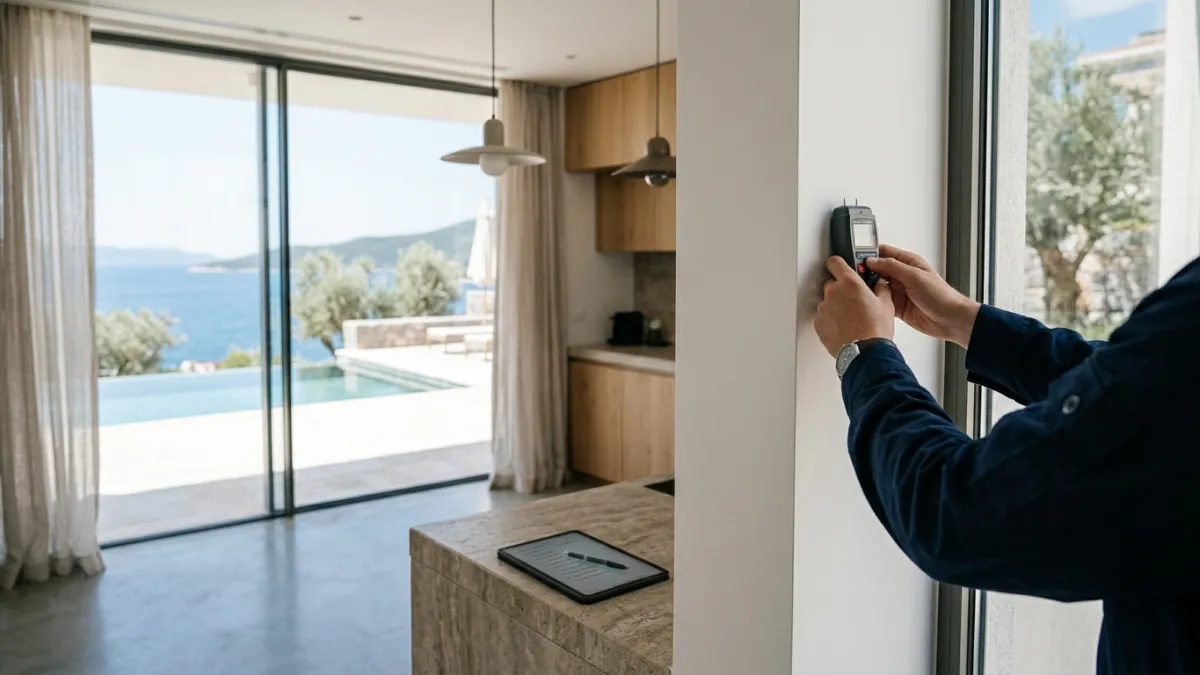
On the coast, damp is the defect I would check first. Look for:
- Tide marks or flaking paint low on walls, especially ground floors and walls against the hillside.
- Dark spots in corners, behind wardrobes and in bathrooms.
- A strong musty smell, or a dehumidifier running during the viewing.
- Fresh paint in only one corner of a room.
A freshly painted flat in autumn is not a problem in itself. A flat painted the week before the viewing, in one patch, deserves a question.
Cracks
Not every crack is serious. Hairline cracks in plaster are common. Cracks that are wider, diagonal from window and door corners, running through to the outside, or repaired several times are a reason to bring in a structural engineer.
Montenegro is an earthquake area. The 1979 earthquake, about magnitude 7, caused heavy damage along the coast from Ulcinj to Herceg Novi. Since August 2023, Eurocode 8 is the only valid seismic design standard. Older buildings were designed to earlier rules, and later additions on top of them were sometimes built without any engineering at all. An extra floor added to an old house is a structural question, not just a legal one.
Roof, terraces and flat roofs
Flat roofs and large terraces are typical on the coast. Look at the ceiling under them for stains. Check whether water drains away or stands. Ask when the waterproofing was last done.
Installations
Check the electrical panel, the age of the wiring, the hot water boiler and the air conditioning units. Ask whether the building has its own water tank and how supply works in the peak of summer. Old installations are not a deal breaker, but they are a cost you should price in.
Shared parts of the building
In an apartment block, look at the stairwell, the lift, the facade and the roof. Ask whether there is a building management arrangement and how shared repairs are paid. A neglected stairwell often tells you more than the show apartment.
Red flags on site: the plot and the surroundings
- Boundaries. Walk the plot. Do the fences match the cadastral plan? A garden that partly belongs to the neighbour is a known issue.
- Access. Is the road to the house public, or does it cross someone else's land?
- Occupancy. Is someone living there, renting it or storing things? Who leaves, and when?
- Construction next door. An empty plot in front of your sea view can be a building site next year. Ask your lawyer to check the zoning.
- Restricted land. Fields, olive groves and forest may be agricultural or forest land. Foreigners can own such land only up to 5,000 m² and only together with a house. Details are in Can Foreigners Buy Property in Montenegro?
Red flags in the behaviour of the seller or agent
Sometimes the warning sign is how people react to normal questions:
- Pressure to pay a reservation fee "today" before you have the title deed.
- A request to put a lower price in the contract than you actually pay. The tax authority can assess the tax on market value anyway, and the risk sits with you.
- Refusal to let your own lawyer or inspector see the property.
- A seller who cannot explain why the area on paper is smaller than the area you see.
How to inspect when you live abroad
Most foreign buyers see a property once, for an hour, in good weather. That is the wrong time to spot damp or traffic noise. If you cannot be there long enough, an independent inspection with photos, video and a written report can fill the gap, as long as the inspector takes no commission from the seller or agent. See the packages.
The legal checks belong to your lawyer. The order in which all of this fits into a purchase is in How to Buy Property in Montenegro as a Foreigner, and the extra costs are in The Hidden Costs of Buying an Apartment in Montenegro.
Your next step
Before your next viewing, ask for three documents: a fresh title deed, the use permit and proof that taxes and utilities are paid. Take them with you and compare them with what you see. If anything does not match, ask about it on the spot.
Frequently asked questions
Is a building in legalisation a safe purchase?
It is a risk. Legalisation needs planning compliance and resolved land rights, and if these fail, removal can be ordered. Let your lawyer verify the exact stage before you agree a price.
What is the best season to inspect a coastal property?
Late autumn or winter after rain shows damp and leaks most clearly. Summer shows noise, parking pressure and how the property works at the busiest time of year.
Should I hire a structural engineer for an older house?
If you see wide, diagonal or repeatedly repaired cracks, or the house has extra floors added later, yes. An engineer can judge whether the structure is sound and what a repair might involve.
Can I ask the seller to fix defects before the sale?
Yes, you can negotiate repairs or a lower price. Put any agreed repairs, deadlines and the condition at handover into the notarised contract.
Sources
- practiceguides.chambers.com - practice-guides/real-estate-2026/montenegro
- cms.law - en/int/expert-guides/cms-expert-guide-to-commercial-real-...
- pvinformer.me - legalizacija-dobila-novi-rok-upis-bespravnih-objekata-pro...
- cdm.me - ekonomija/produzen-rok-za-legalizaciju-jos-sest-mjeseci-z...
- ecoi.net - en/file/local/2132149/montenegro-report-2025.pdf
- en.wikipedia.org - wiki/1979_Montenegro_earthquake
- iisee.kenken.go.jp - worldlist/Web/35_Montenegro.htm
General information, last checked October 18, 2026. Laws, taxes and prices change. This is not legal, tax or investment advice. Check your case with a licensed lawyer before you sign.